Showing posts with label long term care news. Show all posts

Monday, June 3, 2013

June 2013:LTC-Guide News and Updates.

________________________________________________________________________________
John Hancock has announced “gender-distinct pricing, reflecting the male/female differences in the probability of benefit usage.” 

Gender-distinct pricing is not in affect in California.  (I am checking to see if CA has regulations against gender-distinct pricing.)  Only the Compact states of: Alabama, Alaska, Colorado, Georgia, Idaho, Illinois, Iowa, Kansas, Kentucky, Louisiana, Maine, Maryland, Massachusetts, Michigan, Minnesota, Mississippi, Missouri, Nebraska, New Hampshire, New Mexico, North Carolina, Ohio, Oklahoma, Oregon, Pennsylvania, Rhode Island, South Carolina, Tennessee, Texas, Utah, Vermont, Virginia, Washington, West Virginia, Wisconsin, Wyoming.   Additional states will be included upon approval. However, Montana will remain with unisex rates, as it does not permit gender-distinct rates.
_________________________________________________________________________________
Genworth has announced effective July 1 their LTCi Privileged Choice Flex and Privileged Choice Flex Partnership will be available in California on July 1, 2013. 

They are working on CA approved brochures and Illustrations.  Limited CA marketing materials will be approved by June 17th. 

Contact: Charles@LTC-Guide.com for details and updates.


Sunday, March 10, 2013

Genworth Suspention of LTC Sales Is Temperary

                                                                     
Genworth has been selling the Choice Partnership LTC in CA since 1994.  They are scheduled to introduce the Privileged Choice Flex (PCF) in 31 one states on April 15th. California regulators have not yet approved Genworths new product.  In order to halt a prolonged "fire sale" Genworth announced (March 7th) they will temporarily suspend individual policy sales (March 21) in CA until the approval of Privileged Choice Flex.

I anticipate  the PCF to be an un-bundled LTC product at a perhaps 30% or higher premium.  This is do to: 1. Lower than anticipated Lapse Rate (from 6% to about 1%) 2. Low interest earnings on invested assets. 3. Overly optimistic underwriting assumptions.

Genworth has already let us know that they are moving towards: 1. Ending Preferred ratings (10 to 20% savings) 2. Reducing spousal discounts (from 40 to 20%) 3. Eliminating the sale of Lifetime benefits. 4. Moving from unisex to sex distinct  rates. This means men's premium will go down and women's premiums will increase.

Genworth remains the largest underwriter of LTCi in the US.  As noted by LifeHealthPRO - Feb 6, 2013 : Genworth reported a  $8 million net income in the last quarter.  Their gross benefit ratio increased to 126.4 % from 114.1%.  Loss ratio increased to 76.2 % from 67.1% (The have the reserves to pay future claims)

This is what I wrote March 5 Th  on the CA Partnership LinkedIn regarding the Genworth CA Partnership

"...  Remember the positives:
1. Protection from unreasonable rate increases. 
     ( a. DoI & DHCS can't approve any rate increases greater that 40% over a three  
          year period. (requires two separate actuarial audits) 
      b. Total approved rate increases must be spread equally over three-years.
      c. All Partnerhip policies must be kept in a unique risk pool.
      d. requires 85% loss ratio on premium increases) (AB 999)
2. Independent Care Management
3. Asset protection from Medi-Cal and Estate Recovery credit.
4. Monthly reimbursement for Home and Community Care.
5. Protection from unintended Lapses.
6.  Pre-Health Underwriting."

Talking about the evolution of the CA Partnership

"...  Regulations need to be reviewed and modified.  #1 being modification of the required 5% Compound inflation. (Good for 1994-not for 2013).  #2. SB 483 (2008) regulations need to be implemented.  #3. More Insurance Companies need to admitted to the Partnership. (Note: Any positive changes in CPR regulations must be offered to existing policy holders)

The California's DUI and DHCS have been extremely slow in approving Genworth's Privileged Choice Flex.  Other insurance  companies have also complained about the delays in the approval period.   It seems until the State streamlines the system and puts more manpower on problem we will continue to go from crises to crises as companies struggle to provide meaningful long-term care protection.

Thursday, November 29, 2012

2013 Medi-Cal Resource & CA Partnership Limits

Medicaid/Medi-Cal Limits
The 2013 Community Spouse Resource Allowance (CSRA)  is $115,920 up from $113,640 (2012)

The maximum Minimum Monthly Maintenance Needs Allowance (MMMNA) for 2013 is $2,898 up from $2,841 (2012)

2013 (DRA 2005) Home Equity Limits: Minimum $536,000 Maximum $802,000 (CA)

CA Average Semi Private N.H. Rate 2013: $7,098
CA Partnership Minimums 
CA Partnership for Long Term Care Minimum Daily Benefit for 2013 is $170 a day for Nursing Home and $119 per day (70% of N. H.) for Residential Care and Assisted Living. Minimum Monthly reimbursement for Home Care (50% of N.H.) is $85 x 30 = $2,550 and $85 x 31 = $2,635. Average Private Pay (Nursing Home) Rate has not been released.  ( It will most likely to remain at $8,640)

Medicare Part B (Medical Insurance Cost)
If your yearly income in 2011 was
Individual           File Joint Return                You Pay
$85,000               $170,000                         $104.90
$85-$107K          $170-$214K                     $146.90
$107-$160K        $214-$320K                     $209.80
$160-$214K        $320-$428K                     $272.70
above $214k        above $428K                   $335.70 

Skilled Nursing Facility Stay
In 2013, you pay

  • 0 for the first 20 days of each benefit period
  • $148 per day for days 21-100 of each benefit period
  • All cost for each day after 100 of the benefit period


Monday, November 26, 2012

LTCi 401: Policy Benefit Choices and Options


This is an attempt to provide a brief outline of the features and benefits of a Tax Qualified Long Term Care Insurance policy. Descriptions of Choices Options and Features will be discussed at another time.

Choices:
When you decide to purchase LTCi your first choice is what type of policy: Reimbursement, Indemnity or Cash benefit?  Secondly the daily amount: $50-$400 a day.  Then in order to determine the TOTAL amount available in your policy you have a choice of 365 days 1Year (CA Partnership Only) 730 days 2 Year, 1,095 days 3 Year, 1460 Days 4 Year etc.  Some companies may still offer Unlimited (Life Time).

Example: (Reimbursement-No inflation protection)
          $200 of Daily benefit x 1,095 day = $219,000 of Total benefit.
A.   Maximum amount available is no more $200
B.   Total Benefit to be received is $219,000 (LTCi Account Value)
C.   One purchases is dollars not time.  IF one chooses to be reimbursed $100 a day for services received the benefit will last twice as long (6 Years)
Other benefits possibly included in a basic policy: Equipment and Home Modification, Caregiver Training, Respite Care, Bed Reservation, Care Management, Medical Alert, Ambulance service

Options
When considering the purchase of Long-Term Care Insurance there are many options that one needs to consider.  Options increase the cost of the policy.  Some options, like Automatic Inflation are recommended in order to keep pace with the cost of care.  Other options such as Restoration of Benefits are unlikely to occur and are priced accordingly.
Here is a list of options (not all) that are found in policies.  Remember that definitions of these options defer between companies.
·         50%-100% of Nursing Home Benefit for Home Care
·         70%-100% of Nursing Home Benefit For Residential Care
·         Daily or Monthly reimbursement for Home Care
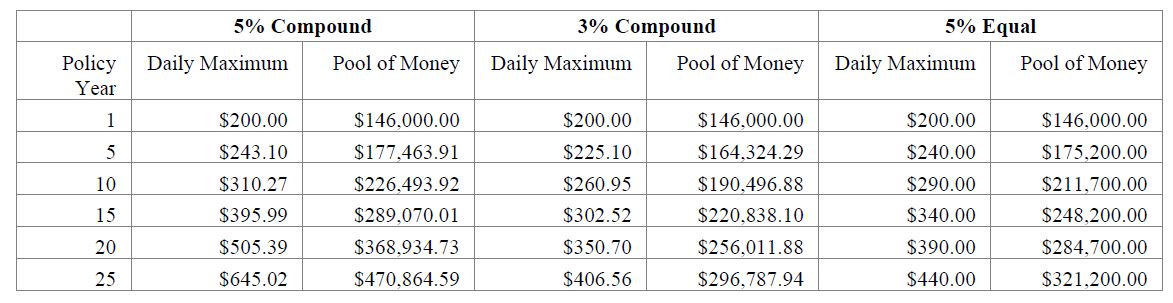
  •           Automatic Inflation Protection
o   5% Compound
o   3% Compound
o   5% Simple

(Provided by Genworth)
o   CPI (Consumer Price Index) Inflation protection


(Provided by John Hancock Ins.)


·         Elimination Period 30, 60, 90, 180, 360 Days
o   Calendar Days or Service Days
o   Without or With: Waiver for Home Care Service
·         Shared-care Benefit
·         Survivorship and Waiver of Premium
·         Dual Waiver of Premium
·         Restoration of Benefits
         Nonforfeiture 


Tuesday, October 23, 2012

LTCi Update and/or Comment: Full-Gale Warning


Storm clouds are on the horizon for Long-Term Care Insurance.  This year Guardian, Prudential and MetLife left the market.  Unum eliminated their Small Group LTCi program.  John Hancock came back into California, however, at a greatly increased premium.

Much of the turmoil is due to the Federal Reserve keeping low yields on the bonds portfolio’s making it difficult to maintain reserves sufficient to cover liabilities that increase by 5% annually.   This compounded by the fact that insured’s do not voluntarily lapsed their coverage at the previously anticipated 6% rate.  Most carriers are seeing less than a 1.5% lapse rate.  (You buy LTCi - You keep LTCi)

Genworth, the largest underwriter of LTCi, is not immune to the fiscal crisis.  They have cut agent’s commissions by 15%, are eliminating unlimited benefits and limited pay options.  In some states Genworth has reduced couples discount from 40 to 20% and eliminated preferred rating discounts.

Now there is talk of charging separate rates for men and for women who buy individual LTCi coverage instead of charging one blended unisex rate.  This will mean higher prices for women. Why?  Women tend to live longer, spend more time receiving long-term care services, and, if they are married, tend to be more likely than men to end up needing formal LTC services, not being able to depend on a spouse to provide the care.

LTCi will survive.  For now, baton down the hatches, set your sea anchor or find a safe harbor and prepare to ride out the storm. 


Conclusion: 
Don't wait for the policies to get better or less expensive, or for others to provide for you.  If it is affordable buy it.  You'll never be younger and probably not healthier than you are today.   

Friday, October 19, 2012

2013 LTCi TAX Limits

2013 Tax Limits for LTCi Announced

THE IRS has released the 2013 limits  (Rev Procedure 2012-41)

Attained Age Before Close of Taxable Year
      40 or less                                                   $ 360         (2012 is $350)
      More than 40 but not more than 50     $ 680          (2012 is $ 660)

     More than 50 but not more than 60     $1,360       (2012 is $1,310)
   
   More than 60 but not more than 70      $3,640      ($3,500)
      More than 70                                             $4,550      ($4,370)


For calendar year 2013, the per-diem limitation under Section 7702B(d)(4) for periodic payments received under a qualified long-term care insurance contract is $320 (the 2012 limit was $310).
    

Saturday, October 13, 2012

Proposed Legislation: Medicaid Long-Term Care Reform Act of 2012

Is this the beginning  of  meaningful legislation promoting pre-planning for long-term care.

H.R.6300 
Latest Title: Medicaid Long-Term Care Reform Act of 2012 
Sponsor: Rep Boustany, Charles W., Jr. [LA-7] (introduced 8/2/2012)      Cosponsors (4) 
Latest Major Action: 8/6/2012 Referred to House subcommittee. Status: Referred to the Subcommittee on Health.

Bold Added by Charles Schug
SUMMARY AS OF: 
8/2/2012--Introduced.
Medicaid Long-Term Care Reform Act of 2012 - Expresses the sense of Congress that: (1) Congress should repeal the Community Living Assistance Services and Supports Act (CLASS Act); (2) federal and state governments should work to reduce the number of middle-income individuals who will rely on Medicaid to finance their long-term care (LTC) needs; and (3) the Secretary of Health and Human Services (HHS) should comply with the annual reporting requirements under the Deficit Reduction Act of 2005 relating to LTC insurance partnerships, and promote discussion about the consequences that families and states might encounter if nothing is done to change the trajectory of projected state and federal spending on LTC services under title XIX (Medicaid) of the Social Security Act (SSA).
Directs the Secretary to provide to states: (1) technical assistance on the implementation and administration of qualified state LTC insurance partnerships, and (2) information on best practices for such partnerships to reduce future state and federal expenditures on LTC services under Medicaid.
Directs the Secretary to: (1) provide technical assistance to states on requirements related to the mandate to seek recoveries from estates, and (2) hold an annual event to assist states in evaluating methods of implementing such requirements and exchanging best practices information on them.
Amends the Deficit Reduction Act of 2005 to direct the Secretary, acting through the National Clearing House for Long-Term Care, to establish a public-private initiative to coordinate among the Clearinghouse, state governments, and relevant nongovernmental entities for: (1) increasing the number of targeted middle-income individuals who receive consumer education with respect to long-term care under Medicaid and SSA title XVIII (Medicare), (2) enhancing the quality of information that targeted consumers receive, and (3) improving the accessibility of such information for consumers who seek it.
Expands Clearinghouse duties to include educating consumers with respect to the availability and limitations of Medicare coverage for long-term care.
Directs the Secretary to: (1) evaluate methods to expand LTC insurance coverage for middle-income individuals through the State Long-Term Care Partnership Program for improving their retirement security and LTC options; (2) solicit and evaluate ideas from stakeholders on policy options to reduce such expenditures; and (3) study the effectiveness of certain federal laws relating to treatment of assets for purposes of determining eligibility for Medicaid long-term care, estate recovery under Medicaid, the look-back period for transfers of assets for purposes of Medicaid eligibility, and the disqualification of individuals with substantial home equity for LTC assistance under Medicaid.
Directs the Director of the Congressional Budget Office (CBO) to report to Congress on: (1) the projection of the number of middle-income people who will rely on Medicaid to finance their LTC needs, (2) an estimate of the cost of reliance on Medicaid to state and federal governments, (3) an estimate of the change in the cost that would result from certain policy options such as reduction in the home equity exemption, and (4) the estimate of the change in the cost estimate that would result if each such policy option were adopted and funding for LTC services under Medicaid is provided to states through a block grant.


Comment:
Are not these studies and assistance  already being done? 
 What should be legislated is: A. above the line deduction for all who purchase LTCi without the 7.1% of adjusted Gross income medical expense requirement.  B. Allowing LTCi to be purchased through a section 125 "Cafeteria plan" with employees  pre-taxed income. C. Providing a TAX Credit for the purchase of LTCi. D. Continue closing the loopholes used by "Medicaid planners" that allows the shifting and shielding of wealthy individuals to qualify for  Medi-Cal (Medicaid).    E.  Educating the Public to the need and cost of long-term care.   The lack of public assistance to the meddle class.  How the purchasing of LTCi when healthy and young can protect your lifetime savings. 

Wednesday, October 10, 2012

LTCi 202: Filial Responsibility


In California as well in about 30 other states there currently are laws making adult children responsible for their parents if their parents can't afford to take care of themselves.  California's Family Code (Sec. 4400) states "Except as otherwise provided by law and adult child shall to the extent of his or her ability, support a parent who is in need and unable to maintain himself or herself by work."

Although California is not currently enforcing this code.   With the passage of the Deficit Reduction Act. and California's eventual implementation it, (SB 483) children could soon be found responsible for the parents well being legally as well as morally.  Read More

This concern should be discussed further with an  Estate Planning  or Elder law attorney.  Two solutions are:

Life Insurance: You may purchase life insurance for your parents.  You would be the owner of the
of the policy and after your parent's death, the proceeds could be used to pay final long-term care bills.

Long-Term Care Insurance: If your parents who qualify, but can not afford , long-term care insurance, you may buy the coverage for them, it could help reduce or eliminate the cost of their care.

Wednesday, September 12, 2012

Part 1 CPR: CA Partnership for Long-Term Care

Note:  The CA Partnership Long-Term Care CE course is  8 hour of instruction Insurance Agents take every two years to be in compliance.  I am primary instructor in Southern CA for
 Senior Insurance Training Services 

California began the CA Partnership for Long Term Care program in 1994, to promote the purchase of private LTC insurance by offering consumers access to Medi-Cal under special eligibility rules should additional LTC coverage (beyond what the policies provide) be needed.

The California Partnership for Long-Term Care with a select number of private insurance companies.  These insurers have agreed to offer high quality policies that meet stringent standards set by the Partnership and the State of California.  These special policies are commonly called “Partnership Policies.”

Unique Aspects Of the Partnership Policy


1. Dollar for Dollar Asset protection for Medi-Cal qualification and Estate Recovery Credit.  
                  Each dollar your Partnership policy pays out in benefits entitles you to 
                  keep a dollar of     your assets if you ever need to apply for Medi-Cal. 
                  Your  protected dollar will also be exempt from any claim theState of California
                  may have against your estate to recover the cost   of State-paid long-term 
                  care or  medical services provided to you.

2. Face to Face Independent Care Management 
Partnership policies include an Independent care management benefit.   The care manager is a health care professional or a social worker who is employed by a care management agency that provides assessment, care coordination, and monitoring.  Works with you to assess your circumstances, determine the specific services you need, develop a plan of care to address your needs and, if you desire, coordinate and monitor services to insure you are cared for appropriately.  The care manager paid for by the Insurer but is contracted through the CA Dept of Health.  Care Managers, are all required to meet specific standards established by the Partnership.


3. Premium Increase Protection.

4. Monthly Reimbursement for Home Care Cost 
    Additional Features To KEEP The Policy IN-FORCE


For Additional Information Regarding the CA Partnership:


Friday, September 7, 2012

CA LTC Agents: AB 999 Passed


Note: AB 999 when first introduced almost guaranteed more Insurance companies exiting CA.  I have reviewed 3 articles and this one published by John Hancock works best for me.

Revised version of California Assembly 999 passed on August 31st  September 7, 2012

Over the past two years, the LTC industry (including John Hancock) has been working with the California Insurance Department (CID) and legislators on revisions to rate stabilization and consumer disclosure requirements.

As originally introduced in early 2011, California Assembly 999 (AB 999) contained provisions which would have a significant and negative impact on the marketplace. The most problematic was the provision that would limit a carrier's ability to raise rates more than every 5 years for pre-rate stabilized business and every 10 years for post-rate stabilized business. This bill was withdrawn in mid-2011 with the caveat that the industry would work with the CID and Legislators on additional reforms.

On August 31st, a revised version of AB 999, that removed the more onerous aspects of the original bill, was passed by the Legislature Key. Provisions of the bill to include the following:

•Actuarial Requirements - The bill adds additional actuarial requirements that must be met by
carriers when filing initial products or rate increases in the area of loss ratios, pooling, interest rates
and contingent nonforfeiture. The bill also allows for a carrier to implement a requested/approved rate increase in smaller annual segments over time. The 5-year/10-year restriction on a carrier's ability to raise rates was not included in the re-introduced and final version of AB 999.
•Enhanced Disclosure & Access to Information - The bill also improves consumer disclosure and
access to information regarding a carrier's long-term care insurance product portfolio.

Next steps – We expect Governor Jerry Brown to sign this bill shortly. California AB 999 will become effective on January 1, 2013.

Monday, September 3, 2012

LTC 101: Policy Design (short-fat vs long-thin)

Two ideas prevail when developing a LTC Reinbursment policy.
1: Short - Fat: A short elimination period (30 or 90 days) of $200 to $400 a day benefit with a two, three or four year multiplier.  
Example $200 x 1095 day = $219,000 first year policy value, 90 day facility 0 day home care, 5% compound inflation. 
    Annual Premium 50 year old couple  $2,708 
 (United of Omaha- Std)
Advantage: Client controls the cash flow.  Depending upon need (cost and length of care) sends all or part of  the covered benefits. 
2. Long-Thin: less Daily benefit x 5 year to eight year multiplier with a long elimination period (180 or 365).
Example: $100 x 2,920 = $292,000 first year value. 365 day elimination period , 5% compound.
    Annual Premium for 50 year old couple $2,356 
 (United of Omaha- Std)
Advantage: Premiums savings because client self insures for the short term.  Only for the catastrophic -LONG TERM- does he have access to the insurance benefit.


Note: Short-Fat design with access to more money earlier is best:  The savings gained for a LONG waiting period does not offset the exposure to the early cost of care. 

Long-Term Care Insurance can be complicated with many decisions required in designing a comprehensive policy.     

Insureds need to take the time to understand the features and definitions that distinguish  each companies coverage.

 "Long-term care insurance can allow loved ones to care ABOUT YOU …instead of having to care FOR YOU."


Tuesday, August 28, 2012

LTC-101 Guide to Senior Living and Care


Below are guides to Senior Living and Care:
Assisted Living, Alzheimer's Care, Residential Care (Board & Care), Nursing Home, Home Care, Home Health Care, Respite Care, Day Care, Care Management etc.

More links to be added latter:

New Life Styles is a guide to locating services for senior care: New Life Styles

Genworth Life Assurance: Genworth Caregiving


Veterans LTC Benefits

   
War Era Veterans and their surviving spouses may be entitled to a tax-free benefit.   This benefit is available for Veterans and their surviving spouses who are spending the majority of their income on health care.


Known websites that provide Free Workshops in the LA/Orange County area are.     

War Era Veterans Alliance
CA Elderlaw Center: Vets Benefits Division

Saturday, July 28, 2012

LTC 101: Analysis of Long Term Care Insurance

My father loved the game of golf.  I learned from his  tutelage, of the game, that if you over think the complexities of your swing you will "duff" the shot.   Deciding on long term care is similar.  Analysis of all the solution one can get loosed in the details. Afraid of making a mistake. Decide to do nothing.   

There are many variables that determine the pricing of LTCi.  I will discuss many of these features in detail in other postings.   

 Of the many factors that effect the availability and price of LTCi.  the most important is ones health."Money Just Pays for Long-Term Care Insurance - Health buys it!".  Age is the next factor.  Companies use ones actual age. Premiums increase after age 50 by 6 to 9% a year.  All LTCi policies are "Guaranteed Renewable" which means the company can never cancel your coverage as long as premiums are paid.  They can, however, increase the premium by class with state approval.

When I was young and first married I asked my fathers " When is the best time to buy a house?"  "When you can afford it." he replied.    Same is true with LTCi.  You will never be younger and probably not healthier than you are today.  Susie Orman an advocate for LTCi now advises "before the age of 58".


Schug The LTC Guy


Tuesday, July 24, 2012

LTC 101: CARE MANAGEMENT (under construction)


The most important feature provided in a Long-Term Care Policy is Care Management.  A professional usually a Registered Nurse or sometimes a Social Worker.  One who assists the family in the planning and implementation of the patients care.  

Even if one does not have a policy it is so important the family seeks counseling from a professional.   

The Care Manager becomes the Coach to help the family manage the maze of services and facilities.  The help develop and implement a plan.  Counseling the family the best way to keep the patient as safe and independent as possible.  


Schug The LTC Guy


Sunday, July 22, 2012

LTC Legal: Durable Power of Attorney & Medical Directive

Disclaimer: " I am not an attorney.  Any legal advice that I share, check with an attorney.  I am not responsible for anything I say".  Words like this I say in all my Long-Term Care CE classes.

Two vital documents are necessary in order for a loved one (family member or friend) to properly take care and act on your wishes they are : Durable Power of Attorney and a Medical Directive.  Both are legal documents that allows a person of your choice to make the Financial/legal and Medical decisions if/when due to accident, illness or cognitive impairment you are not competent to decide.  They may be included in a Will, or Living Trust.

A marriage license is not a valid document for this purpose.  Insurance companies and financial planners are bound by privacy laws so therefore cannot discuss or execute with any other party without a durable power of attorney.   Medical practitioners will continue to provide care unless you have executed and appointed a person, of your choice, to make these decisions.         

A doctor wrote a one line letter "...this patient is not mentally competent to make her own financial decisions"     Allowing my wife to take over her mothers finances and preserve what was left of her financial investments.

Later my mother in law was certified for Hospice Care.  Because of the Medical Directive she was allowed  to remain at our house and die with dignity with family at her bedside.  

Saturday, July 21, 2012

LTC 101 Care Continuum / How Benefits Trigger

Generally long-term care refers to a wide range of of personal care and other services provided over an extended period of time (90 days) to people who need help with basic activities of daily living (ADL's) or who need supervision due to severe cognitive impairment.  This can occur due to aging (frailty),disease, or accident.

How Benefits Are Triggered
In 1996 Federal  Government passed the "Health Insurance Portability and Accountability Act" (HIPAA) that set the standards on how benefits would be triggered  for all Long-Term Care Insurance.  Either the need for "substantial assistance" in at least two of six ADL's (Bathing, Dressing, Transferring, Toileting, Continence and Eating). Or due to "severe" cognitive impairment needing "substantial supervision". 
  • Substantial assistance meaning either in the form of "hands on assistance" or "standby assistance". 
  • Severe cognitive impairment means a loss of intellectual capacity to the point that one is endangering himself or those around him
  • Standards are certified by a licensed health care practitioner and meet the 90 day requirement.

Home Care
Traditionally Home Care begins at home with the support of family and friends.  With a plan of care provided by a "Care Manager" LTCi can provide reimbursement for the cost of.


  • Personal Assistance provided by a  "Care Giver"
    • Bathing, Dressing, Transferring
    • Respite Care
  • Homemaker Services
    • Shopping/Driving
    • Money Management
    • Meal Preparation
    • Medication Management
    • Light Housework
  • Home Health Care provided by a licensed medical  practitioner
  • Hospice Care for the Terminally ill (Note: Long Term Care Insurance will coordinate with Medicare) 
  • Adult Day Care provided in the community


Facility Care 
Home care is practical only for those with limited need for assistance - one that does not involve extensive medical treatment or continuous care or observation. Facility care is at times more appropriate in serving the patients needs. There are two types of  Care Facilities: Residential Care (RCF) and Skilled Nursing Facility (SNF) or Nursing Home. 

Assisted Living provides for a social environment with 24-hour supervision and assistance to residence who have minor medical problems and may or may not need help with bathing, dressing and transferring.  Some Assisted Living facilities provide safe secured areas for those who with mild to moderate cognitive impairment.   These communities offer private, semi-private or small apartments.  They typically provide social activities and a central dinning room.  They typically charge a monthly fee with additional services added depending  the level of care required.  

Board and Care facilities are converted single family homes providing assistance for up to six residents.  They provide “hands on care” with a more home-like atmosphere.  Some facilities off secure supervision and may also provide recreational and social activites.

Skilled Nuring Facility also referred to as nursing home, conversant hospitals or vocational rehab facility provide for 24 hour nursing services.  Many SNF’s off sub-acute care and specialized medical programs like: respiratory therapy services,ventilator care, tracheotomy care , IV services and Hospice.  Sage 3 -4 Alzeihmer’s  or dementia facilities are also licensed as SNF’s.

Summary: RCF’s provide a Social environment and can assist in providing three ADL’s  (Dressing, Bathing and Transferring).  SNF’s provide a Medical environment for patients who require medical assistance on a daily basis.


 SchugTheLTCGuy.com


Thursday, July 19, 2012

LTC 101 Defining Long-Term Care

I will attempt to clear up the confusion about Long-Term Care insurance.  Having been involved with not only product sales but the education of  insurance Agents since 1994, my perspective is unique.

Long-Term Care is needed when due to: accident, illness, frailty or loss of cognitive ability creates the need of human assistance to remain  independent.   This care can be provided at home, in the community or in a facility.  Long Term Care insurance (LTCi) provides the funds to pay for care.  This is a very personal subject,which involves the family and  making choices that will determine the quality, affordability and availability of care.

Although thought to be  a senior insurance product,  care can be required at any age.  Long Term Care insurance must be obtained  before you require assistance.  My first lesson was: " Money just pays for it.  Health buys it."

Golf taught me that "over analysis lead to paralysis".   There are numerous options to help  fund your long-term care needs: saving, life insurance. annuities, depending on spouse and/or children, reverse mortgage or just do nothing and pray.  With so many choices do not fail to plan.  
7/19/12 SchugTheLTCGuy.com