Showing posts with label LTC update. Show all posts

Thursday, December 6, 2012

"Just the Fact Mam" Who need LTCi Services


For years I have used the Nursing Home Statistics provided by the CA Partnership for LTC.  to support the planning for long-term care, Which is: 

Of the People who reached age 65: Men 1 out of 3, Women 1 out of 2 will need a Nursing Home before death.  The average stay will be 2.5 to 3 years.  For everyone who needs a Nursing Home 4 will be taken care of at home.


I have said it so many times it has lost it's meaning.   So hear are some new stats that I hope will bring back into focus the growing long-term care need.


According to the U.S. Department of Health and Human Services, in 2007, about nine million men and women over the age of 65 will need long-term care services. By 2020, 12 million older Americans will need long-term care. Most will be cared for at home. In fact, an agency study revealed that family and friends are the sole caregivers for 70 percent of all elderly Americans needing long-term care. The research also showed that people who reach age 65 have a 40 percent chance of entering a nursing home during their lifetime. About 10 percent of the people who enter a nursing home will stay for five years or more.
A research project concerning the likelihood of needing long-term care services was conducted by Milliman USA, (an actuarial consulting firm). The results of the study were published in the December 2005 edition of LTCi Sales Strategies magazine:
Out of every 1,000 65-year-old policyholders:
- 449 will need LTC services
- 106 will need LTC for > 2 years
- 59 will need LTC for > 3 years
- 34 will need LTC for > 4 years
- 20 will need LTC for > 5 years
The length of stay also varies significantly depending on the policyholder’s gender and whether the policyholder is married or single. The two “extremes” for a 65-year old are shown (that for a married male (lowest) and a single female (highest)):
Out of every 1,000 married 65-year-old males:
- 302 will need LTC services
- 20 will need LTC for > 2 years
- 12 will need LTC for > 3 years
- 7 will need LTC for > 4 years
- 4 will need LTC for > 5 years
Out of every 1,000 single 65-year-old females:
- 555 will need LTC services
- 70 will need LTC for > 2 years
- 51 will need LTC for > 3 years
- 35 will need LTC for > 4 years
- 23 will need LTC for > 5 years
Joe Friday on Dragnet always said "Just the facts mam."   

These are the facts.  So what? Facts mean little unless accompanied with "Personal Experience".    Again emotion triumphs  logic.   Facts don't motivate-real life experiences do.
 It is Life that occurs while weighing the facts. 

Monday, November 26, 2012

LTCi 401: Policy Benefit Choices and Options


This is an attempt to provide a brief outline of the features and benefits of a Tax Qualified Long Term Care Insurance policy. Descriptions of Choices Options and Features will be discussed at another time.

Choices:
When you decide to purchase LTCi your first choice is what type of policy: Reimbursement, Indemnity or Cash benefit?  Secondly the daily amount: $50-$400 a day.  Then in order to determine the TOTAL amount available in your policy you have a choice of 365 days 1Year (CA Partnership Only) 730 days 2 Year, 1,095 days 3 Year, 1460 Days 4 Year etc.  Some companies may still offer Unlimited (Life Time).

Example: (Reimbursement-No inflation protection)
          $200 of Daily benefit x 1,095 day = $219,000 of Total benefit.
A.   Maximum amount available is no more $200
B.   Total Benefit to be received is $219,000 (LTCi Account Value)
C.   One purchases is dollars not time.  IF one chooses to be reimbursed $100 a day for services received the benefit will last twice as long (6 Years)
Other benefits possibly included in a basic policy: Equipment and Home Modification, Caregiver Training, Respite Care, Bed Reservation, Care Management, Medical Alert, Ambulance service

Options
When considering the purchase of Long-Term Care Insurance there are many options that one needs to consider.  Options increase the cost of the policy.  Some options, like Automatic Inflation are recommended in order to keep pace with the cost of care.  Other options such as Restoration of Benefits are unlikely to occur and are priced accordingly.
Here is a list of options (not all) that are found in policies.  Remember that definitions of these options defer between companies.
·         50%-100% of Nursing Home Benefit for Home Care
·         70%-100% of Nursing Home Benefit For Residential Care
·         Daily or Monthly reimbursement for Home Care
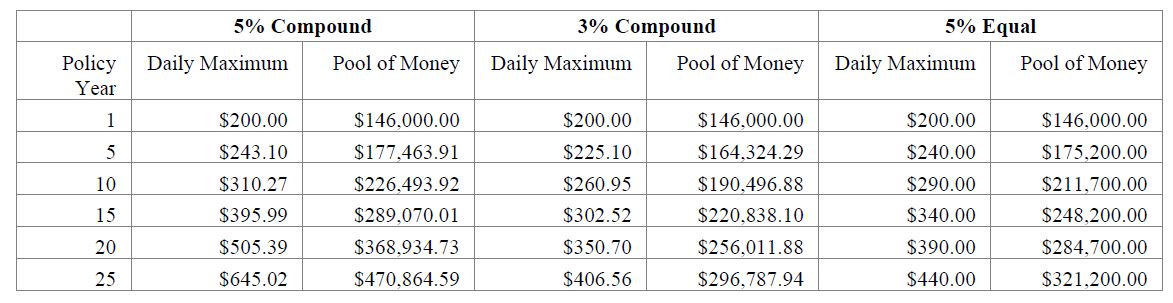
  •           Automatic Inflation Protection
o   5% Compound
o   3% Compound
o   5% Simple

(Provided by Genworth)
o   CPI (Consumer Price Index) Inflation protection


(Provided by John Hancock Ins.)


·         Elimination Period 30, 60, 90, 180, 360 Days
o   Calendar Days or Service Days
o   Without or With: Waiver for Home Care Service
·         Shared-care Benefit
·         Survivorship and Waiver of Premium
·         Dual Waiver of Premium
·         Restoration of Benefits
         Nonforfeiture 


Tuesday, October 23, 2012

LTCi Update and/or Comment: Full-Gale Warning


Storm clouds are on the horizon for Long-Term Care Insurance.  This year Guardian, Prudential and MetLife left the market.  Unum eliminated their Small Group LTCi program.  John Hancock came back into California, however, at a greatly increased premium.

Much of the turmoil is due to the Federal Reserve keeping low yields on the bonds portfolio’s making it difficult to maintain reserves sufficient to cover liabilities that increase by 5% annually.   This compounded by the fact that insured’s do not voluntarily lapsed their coverage at the previously anticipated 6% rate.  Most carriers are seeing less than a 1.5% lapse rate.  (You buy LTCi - You keep LTCi)

Genworth, the largest underwriter of LTCi, is not immune to the fiscal crisis.  They have cut agent’s commissions by 15%, are eliminating unlimited benefits and limited pay options.  In some states Genworth has reduced couples discount from 40 to 20% and eliminated preferred rating discounts.

Now there is talk of charging separate rates for men and for women who buy individual LTCi coverage instead of charging one blended unisex rate.  This will mean higher prices for women. Why?  Women tend to live longer, spend more time receiving long-term care services, and, if they are married, tend to be more likely than men to end up needing formal LTC services, not being able to depend on a spouse to provide the care.

LTCi will survive.  For now, baton down the hatches, set your sea anchor or find a safe harbor and prepare to ride out the storm. 


Conclusion: 
Don't wait for the policies to get better or less expensive, or for others to provide for you.  If it is affordable buy it.  You'll never be younger and probably not healthier than you are today.