Thursday, November 29, 2012

2013 Medi-Cal Resource & CA Partnership Limits

Medicaid/Medi-Cal Limits
The 2013 Community Spouse Resource Allowance (CSRA)  is $115,920 up from $113,640 (2012)

The maximum Minimum Monthly Maintenance Needs Allowance (MMMNA) for 2013 is $2,898 up from $2,841 (2012)

2013 (DRA 2005) Home Equity Limits: Minimum $536,000 Maximum $802,000 (CA)

CA Average Semi Private N.H. Rate 2013: $7,098
CA Partnership Minimums 
CA Partnership for Long Term Care Minimum Daily Benefit for 2013 is $170 a day for Nursing Home and $119 per day (70% of N. H.) for Residential Care and Assisted Living. Minimum Monthly reimbursement for Home Care (50% of N.H.) is $85 x 30 = $2,550 and $85 x 31 = $2,635. Average Private Pay (Nursing Home) Rate has not been released.  ( It will most likely to remain at $8,640)

Medicare Part B (Medical Insurance Cost)
If your yearly income in 2011 was
Individual           File Joint Return                You Pay
$85,000               $170,000                         $104.90
$85-$107K          $170-$214K                     $146.90
$107-$160K        $214-$320K                     $209.80
$160-$214K        $320-$428K                     $272.70
above $214k        above $428K                   $335.70 

Skilled Nursing Facility Stay
In 2013, you pay

  • 0 for the first 20 days of each benefit period
  • $148 per day for days 21-100 of each benefit period
  • All cost for each day after 100 of the benefit period


Monday, November 26, 2012

LTCi 401: Policy Benefit Choices and Options


This is an attempt to provide a brief outline of the features and benefits of a Tax Qualified Long Term Care Insurance policy. Descriptions of Choices Options and Features will be discussed at another time.

Choices:
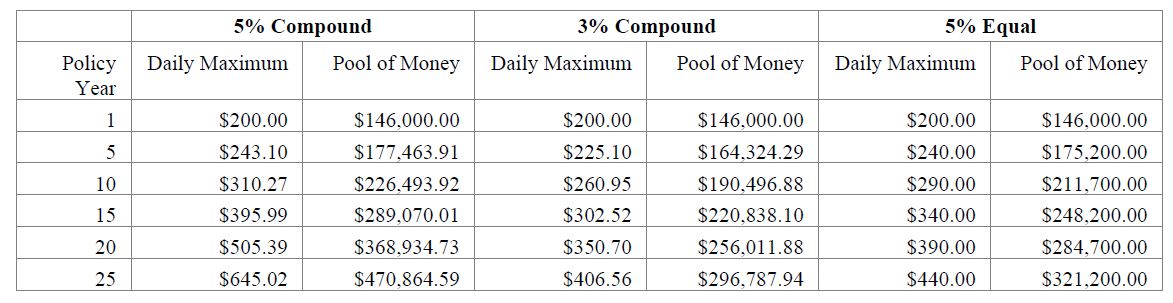
When you decide to purchase LTCi your first choice is what type of policy: Reimbursement, Indemnity or Cash benefit?  Secondly the daily amount: $50-$400 a day.  Then in order to determine the TOTAL amount available in your policy you have a choice of 365 days 1Year (CA Partnership Only) 730 days 2 Year, 1,095 days 3 Year, 1460 Days 4 Year etc.  Some companies may still offer Unlimited (Life Time).

Example: (Reimbursement-No inflation protection)
          $200 of Daily benefit x 1,095 day = $219,000 of Total benefit.
A.   Maximum amount available is no more $200
B.   Total Benefit to be received is $219,000 (LTCi Account Value)
C.   One purchases is dollars not time.  IF one chooses to be reimbursed $100 a day for services received the benefit will last twice as long (6 Years)
Other benefits possibly included in a basic policy: Equipment and Home Modification, Caregiver Training, Respite Care, Bed Reservation, Care Management, Medical Alert, Ambulance service

Options
When considering the purchase of Long-Term Care Insurance there are many options that one needs to consider.  Options increase the cost of the policy.  Some options, like Automatic Inflation are recommended in order to keep pace with the cost of care.  Other options such as Restoration of Benefits are unlikely to occur and are priced accordingly.
Here is a list of options (not all) that are found in policies.  Remember that definitions of these options defer between companies.
·         50%-100% of Nursing Home Benefit for Home Care
·         70%-100% of Nursing Home Benefit For Residential Care
·         Daily or Monthly reimbursement for Home Care
  •           Automatic Inflation Protection
o   5% Compound
o   3% Compound
o   5% Simple

(Provided by Genworth)
o   CPI (Consumer Price Index) Inflation protection


(Provided by John Hancock Ins.)


·         Elimination Period 30, 60, 90, 180, 360 Days
o   Calendar Days or Service Days
o   Without or With: Waiver for Home Care Service
·         Shared-care Benefit
·         Survivorship and Waiver of Premium
·         Dual Waiver of Premium
·         Restoration of Benefits
         Nonforfeiture 


Wednesday, October 31, 2012

November is Long-Term Care Awareness Month


“When faced with two equally tough choices, most people choose the third choice: to not choose.".....Jarod Kintz

The question is not if you'll need care, but when.  The best time to plan for care was yesterday. However , you'll never be younger and probably not healthier than today.


You can't avoid aging, it happens.  With good health habits you can enjoy a long life.   Still the potential of needing assistance improves the longer you live.  Your options when in good health are two: 1. Taking on the risk yourself  2. Transfer the risk with: Traditional Long-Term Care Insurance or Life Insurance with a long-term care rider.  When you lose your health your options are still two: 1. Take on the risk yourself. 2 Transfer your estate to become a "ward of the state".  


The simple truth is LTC insurance remains the best option to protect individuals and their families.  The insurance and financial industry needs to be more effective in educating the public that medical and disability benefits do not cover LTC, as well the limitations of government programs, like Medicare and Medi-Cal.  


It is vital to take action, be proactive in long-term care planning.


“A year from now you may wish you had started today.”.....Karen Lamb


Tuesday, October 23, 2012

LTCi Update and/or Comment: Full-Gale Warning


Storm clouds are on the horizon for Long-Term Care Insurance.  This year Guardian, Prudential and MetLife left the market.  Unum eliminated their Small Group LTCi program.  John Hancock came back into California, however, at a greatly increased premium.

Much of the turmoil is due to the Federal Reserve keeping low yields on the bonds portfolio’s making it difficult to maintain reserves sufficient to cover liabilities that increase by 5% annually.   This compounded by the fact that insured’s do not voluntarily lapsed their coverage at the previously anticipated 6% rate.  Most carriers are seeing less than a 1.5% lapse rate.  (You buy LTCi - You keep LTCi)

Genworth, the largest underwriter of LTCi, is not immune to the fiscal crisis.  They have cut agent’s commissions by 15%, are eliminating unlimited benefits and limited pay options.  In some states Genworth has reduced couples discount from 40 to 20% and eliminated preferred rating discounts.

Now there is talk of charging separate rates for men and for women who buy individual LTCi coverage instead of charging one blended unisex rate.  This will mean higher prices for women. Why?  Women tend to live longer, spend more time receiving long-term care services, and, if they are married, tend to be more likely than men to end up needing formal LTC services, not being able to depend on a spouse to provide the care.

LTCi will survive.  For now, baton down the hatches, set your sea anchor or find a safe harbor and prepare to ride out the storm. 


Conclusion: 
Don't wait for the policies to get better or less expensive, or for others to provide for you.  If it is affordable buy it.  You'll never be younger and probably not healthier than you are today.   

Friday, October 19, 2012

2013 LTCi TAX Limits

2013 Tax Limits for LTCi Announced

THE IRS has released the 2013 limits  (Rev Procedure 2012-41)

Attained Age Before Close of Taxable Year
      40 or less                                                   $ 360         (2012 is $350)
      More than 40 but not more than 50     $ 680          (2012 is $ 660)

     More than 50 but not more than 60     $1,360       (2012 is $1,310)
   
   More than 60 but not more than 70      $3,640      ($3,500)
      More than 70                                             $4,550      ($4,370)


For calendar year 2013, the per-diem limitation under Section 7702B(d)(4) for periodic payments received under a qualified long-term care insurance contract is $320 (the 2012 limit was $310).
    

LTC NEWS: CalPERS Tried LTC and failed (under construction)

I was there in 1996 when CalPERS came out with LTCi for public employee's and teacher.  They competed directly with LTCi insurance companies, but was not regulated as insurance.  This is a self funded program not "insurance".  Was not regulated by CA Dpt. of Insurance. 


Early policies were 90 service day elimination / 50% of Nursing Home Home & RCF benefit.


I believe their primary problem underwriting that permitted employees with existing chronic health problems coverage.   They were adversely selected by their employees.   
The lower than expected-investment-gains has effected all LTCi insurance companies.  Since most policies have a 5% compound inflation benefit that doubles the daily benefit in 15 year.

Lesson to be learned: Government should regulate not compete with the medical insurance industry.  This was a virgin LTCi benefit.   CalPERs was trying to provide a benefit already available by private insurance.   They FAILED.  Their employees will suffer.  The LTCi industry will suffer.   

Note:
CalPERS 1 & 2 year coverage are CA Partnership policies which did has not suffered like their 3, six and Lifetime coverage. 


sacbee.com

CalPERS committee votes to hike rates for long-term care insurance

Published: Tuesday, Oct. 16, 2012 - 11:54 am
Last Modified: Tuesday, Oct. 16, 2012 - 1:36 pm
Bold added by Charles Schug
A CalPERS committee today approved an 85 percent rate hike for the organization's troubled long-term care insurance program, despite protests from retirees.
The increase, assuming it's approved by the full CalPERS governing board, would affect some 112,000 public employees and retirees who have bought the coverage, or about three quarters of all the policyholders. It would be phased in over two years starting in 2015. Policyholders would have the option of getting a 79 percent increase - if they agree to absorb it in one year.
Kathy Donneson, CalPERS' chief of health plan administration, called the increase "the best course of action to create stability in the fund."
The CalPERS pension and health benefits committee voted 9-0 to approve the increase. The proposal goes to the the full CalPERS board Wednesday.
The rate hike would cost policyholders hundreds or thousands of dollars a year in additional premiums, depending on their age. The program, which pays for stays in nursing and convalescent homes, is suffering financially from lower-than-expected investment gains and higher-than-expected claims.
Unlike its pension plans, CalPERS' long term care program doesn't get taxpayer support. CalPERS officials say the plan is solvent for now but faces significant shortfalls in years to come if rates don't rise.
"Not doing this will cause the plan to fail," said committee member Tricia Wynne, representing State Treasurer Bill Lockyer.
Retirees said the higher rates would create an enormous hardship. "It represents a threat to the retirement security of many of the retirees," said Phil Sherwood, executive director of California State Retirees.
The CalPERS committee also voted to create a less comprehensive benefit package that's designed to spare policyholders the big increase. Instead of lifetime benefits, the plan would cover 10 years. CalPERS officials said only 1 percent of policyholders need more than 10 years worth of benefits.

Saturday, October 13, 2012

Proposed Legislation: Medicaid Long-Term Care Reform Act of 2012

Is this the beginning  of  meaningful legislation promoting pre-planning for long-term care.

H.R.6300 
Latest Title: Medicaid Long-Term Care Reform Act of 2012 
Sponsor: Rep Boustany, Charles W., Jr. [LA-7] (introduced 8/2/2012)      Cosponsors (4) 
Latest Major Action: 8/6/2012 Referred to House subcommittee. Status: Referred to the Subcommittee on Health.

Bold Added by Charles Schug
SUMMARY AS OF: 
8/2/2012--Introduced.
Medicaid Long-Term Care Reform Act of 2012 - Expresses the sense of Congress that: (1) Congress should repeal the Community Living Assistance Services and Supports Act (CLASS Act); (2) federal and state governments should work to reduce the number of middle-income individuals who will rely on Medicaid to finance their long-term care (LTC) needs; and (3) the Secretary of Health and Human Services (HHS) should comply with the annual reporting requirements under the Deficit Reduction Act of 2005 relating to LTC insurance partnerships, and promote discussion about the consequences that families and states might encounter if nothing is done to change the trajectory of projected state and federal spending on LTC services under title XIX (Medicaid) of the Social Security Act (SSA).
Directs the Secretary to provide to states: (1) technical assistance on the implementation and administration of qualified state LTC insurance partnerships, and (2) information on best practices for such partnerships to reduce future state and federal expenditures on LTC services under Medicaid.
Directs the Secretary to: (1) provide technical assistance to states on requirements related to the mandate to seek recoveries from estates, and (2) hold an annual event to assist states in evaluating methods of implementing such requirements and exchanging best practices information on them.
Amends the Deficit Reduction Act of 2005 to direct the Secretary, acting through the National Clearing House for Long-Term Care, to establish a public-private initiative to coordinate among the Clearinghouse, state governments, and relevant nongovernmental entities for: (1) increasing the number of targeted middle-income individuals who receive consumer education with respect to long-term care under Medicaid and SSA title XVIII (Medicare), (2) enhancing the quality of information that targeted consumers receive, and (3) improving the accessibility of such information for consumers who seek it.
Expands Clearinghouse duties to include educating consumers with respect to the availability and limitations of Medicare coverage for long-term care.
Directs the Secretary to: (1) evaluate methods to expand LTC insurance coverage for middle-income individuals through the State Long-Term Care Partnership Program for improving their retirement security and LTC options; (2) solicit and evaluate ideas from stakeholders on policy options to reduce such expenditures; and (3) study the effectiveness of certain federal laws relating to treatment of assets for purposes of determining eligibility for Medicaid long-term care, estate recovery under Medicaid, the look-back period for transfers of assets for purposes of Medicaid eligibility, and the disqualification of individuals with substantial home equity for LTC assistance under Medicaid.
Directs the Director of the Congressional Budget Office (CBO) to report to Congress on: (1) the projection of the number of middle-income people who will rely on Medicaid to finance their LTC needs, (2) an estimate of the cost of reliance on Medicaid to state and federal governments, (3) an estimate of the change in the cost that would result from certain policy options such as reduction in the home equity exemption, and (4) the estimate of the change in the cost estimate that would result if each such policy option were adopted and funding for LTC services under Medicaid is provided to states through a block grant.


Comment:
Are not these studies and assistance  already being done? 
 What should be legislated is: A. above the line deduction for all who purchase LTCi without the 7.1% of adjusted Gross income medical expense requirement.  B. Allowing LTCi to be purchased through a section 125 "Cafeteria plan" with employees  pre-taxed income. C. Providing a TAX Credit for the purchase of LTCi. D. Continue closing the loopholes used by "Medicaid planners" that allows the shifting and shielding of wealthy individuals to qualify for  Medi-Cal (Medicaid).    E.  Educating the Public to the need and cost of long-term care.   The lack of public assistance to the meddle class.  How the purchasing of LTCi when healthy and young can protect your lifetime savings.